The Walking Dead Issue 7 (2004)
Publisher: Image Comics
Read Free Comics Online of The Walking Dead Issue 7 (2004) Read Free Online with very high-quality images on google without any cost, Read Free Image comics online at Read Free comics Online.
Scroll down to read free comics online.
The Walking Dead Issue 7 (2004) Read Free Image Comics Online
The narrative matrix recalibrates, processing the typographical glitch and executing a seamless transition into the opening chapter of the second major story arc, “Miles Behind Us.” Released to retail and digital comic channels on June 23, 2004, The Walking Dead Issue 7 (2004) boots up a grueling new environmental travel script. Written under the continuous tight architectural guidance of Robert Kirkman and visual-mapped through the heavily shadowed, bleak ink-work of Charlie Adlard, this details-rich installment tracks the survivor directory as they abandon the compromised Atlanta quarry perimeter entirely, venturing out into the unpatched, maximum-danger highway grids of a dead continent.
The primary mechanical driver of The Walking Dead Issue 7 (2004) centers on a high-stakes “Mobile Survival Logistics, Resource Depletion, and Environmental Scanning Loop.” Having packed their remaining life assets into Dale’s RV and a small caravan of salvaged vehicles, the tribal registry initiates a nomadic migration pattern. The tracking loops log a severe runtime strain inside the panel grid of The Walking Dead Issue 7 (2004) as the group faces an immediate processing bottleneck: winter is rapidly approaching, fuel cells are steadily evaporating, and the physical frameworks of the survivors are running dangerously close to a starvation-induced shutdown, forcing a manual override of their pathfinding subroutines to secure basic nourishment.
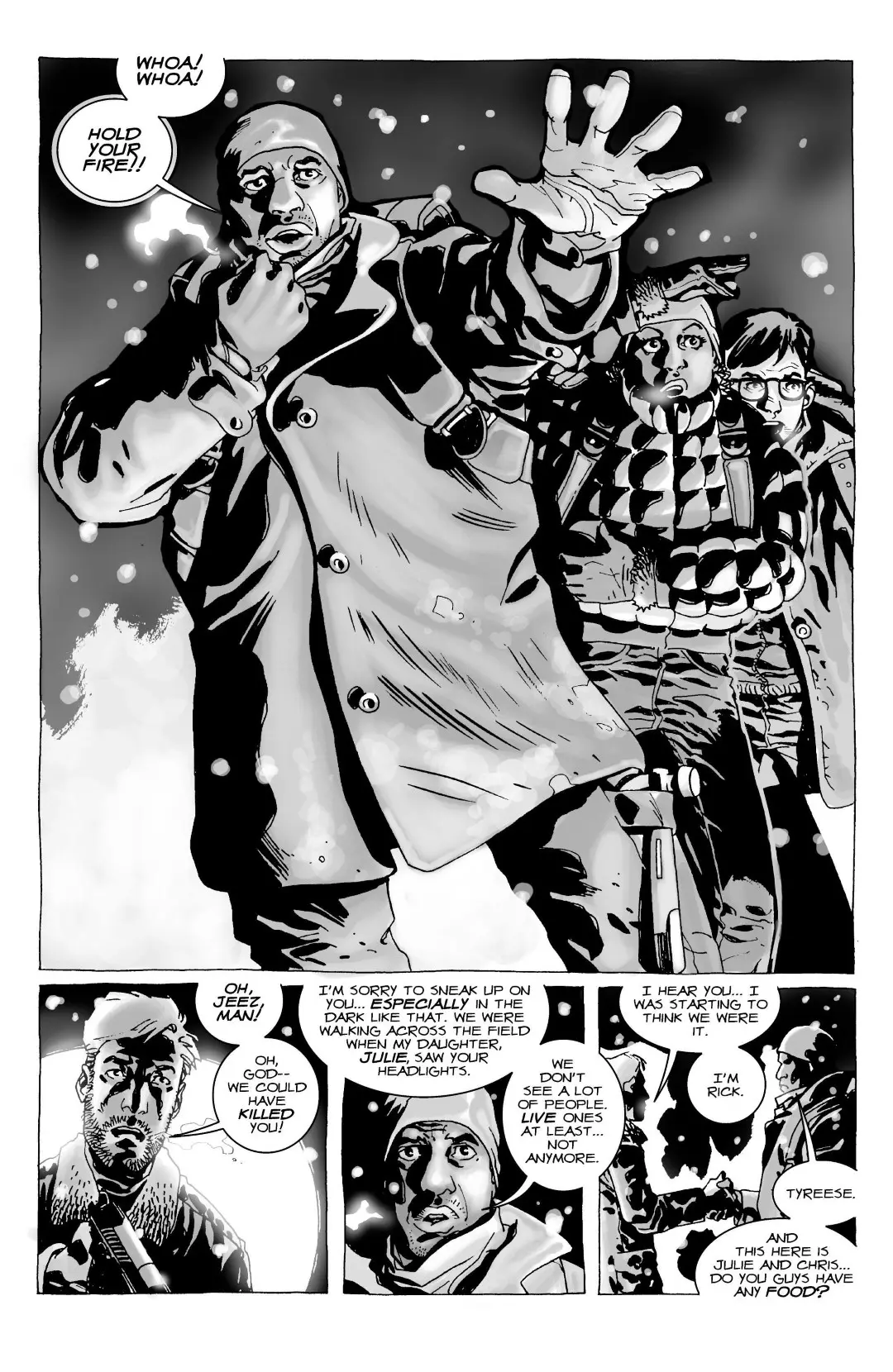
Transitioning from this grueling interstate trek to a display of “New Asset Introductions and Tribal Directory Expansion,” the secondary tracking loops of The Walking Dead Issue 7 (2004) monitor a crucial database update when the caravan encounters a trio of independent survival assets on the road. The panel grid logs an intense validation sync as Rick Grimes cross-references security protocols with Tyreese, a powerful and pragmatic former football player, his teenage daughter Julie, and her boyfriend Chris. Throughout the gripping pages of The Walking Dead Issue 7 (2004), this integration process runs at a high emotional temperature; while the addition of Tyreese provides a massive kinetic firepower upgrade to the group’s defensive frontline, the expanding mouth-to-ration ratio puts a critical strain on their remaining food caches.
Imagine standing on a freezing, asphalt highway in The Walking Dead Issue 7 (2004), the bitter winter wind slicing through your thin jacket as you look into the eyes of a giant stranger holding a hammer, realizing that while you desperately need his physical strength to patch your defensive perimeters against the undead, every new human file you admit into your directory reduces the lifespan of the family assets you are programmed to protect. This issue masterfully shifts the strategic velocity of the 2004 lore, demonstrating that when a global civilization database goes permanently offline, the open road offers no peacetime buffers, transforming simple geographic transit into a relentless war of resource allocation and split-second psychological triage.
Meanwhile, deep-clearance internal diagnostics shift focus to the simmering undercurrents of trauma hardcoded into the group’s internal memory banks. While Rick and Tyreese establish an immediate, mutual respect protocol to coordinate the convoy’s security layout, the auxiliary tracking registries record an intense performance lag within young Carl Grimes. Having executed the lethal deletion script on Shane Walsh in the previous sector, Carl’s civilian programming remains deeply fractured, running silent, unbuffered cycles of shock that Lori Grimes fears will permanently overwrite the boy’s humanity before the system can achieve stability.
The artistic department delivers another absolute masterclass in gritty, high-contrast monochrome styling and expansive visual framing throughout The Walking Dead Issue 7 (2004), with Charlie Adlard optimizing the visual real estate to capture the sheer, daunting isolation of the open road. The formatting flawlessly utilizes the black-and-white layouts inside The Walking Dead Issue 7 (2004), contrasting the vast, empty horizons of the abandoned highways against the cramped, claustrophobic interiors of the moving vehicles. Adlard’s illustrations steer the reader’s eye straight into the heart of the expanding structural trauma, masterfully capturing the imposing, heavy silhouette of Tyreese’s entrance, the weathered, hollow exhaustion etching itself into the faces of legacy survivors like Carol and Andrea, and the bleak, chilling grey tones that warn of the impending winter storm.
The script hits its definitive terminal shutdown sequence as this opening layer of the nomadic campaign successfully archives, leaving the narrative codebase locked onto an irreversible, high-risk alert trajectory heading straight into a search for a permanent winter safehouse. Kirkman utilizes this high-velocity narrative milestone inside The Walking Dead Issue 7 (2004) to permanently shred any remaining ties to the old status quo, ensuring that the characters are completely exposed to the elements and poised on the absolute edge of an un-buffered environmental crisis. To trace the precise visual logs of this historic survival transition before the next defensive line collapses, fans consistently turn to the archived volumes of this legendary independent print run.
Examining the core components of this chapter, the narrative effectively transforms a forced retreat into an explosive launchpad for broader systemic survival, proving that when the primary sanctuaries of an old world are abandoned, the system registry must continuously adapt to mobile threat profiles to prevent a total tribal crash. With the tactical data files of The Walking Dead Issue 7 (2004) fully archived, the newly expanded survivor directory operating under severe resource deficits, and the freezing environmental tracking arrays registering a steady decline in temperature, the volume terminates its runtime with the active monitoring lines flashing a cautious, permanent yellow. The temporary preparation safe buffer has officially hit absolute zero, the primary conflict vectors have cross-referenced, and the entire storytelling mainframe of The Walking Dead Issue 7 (2004) is quietly initializing the code for the next high-voltage deployment phase.
The Walking Dead Issue 7 (2004) Read Free Image Comics Online




Read Free Comics Online of all comics character on this website with very high-quality images on google free.



Leave a Reply